How to play, on video
In under two minutes: train with minigames, win matches, grow your club and climb the ranking. It has voice and subtitles, so it works with or without sound.

Read the video summary as text
- Train. It all starts by training your players with the minigames. There are four kinds of challenge (reflexes, visual speed, memory and logic) and each one adds skills: defense, pass, attack and energy. You choose which player to train and every minigame adds those skills to him, which later help you win matches.
- Play matches. With your skills trained, you play matches to earn money. Every play is decided by you, with your minigames.
- Grow your club. With that money you sign players to expand the squad, place them on the pitch (their position makes the team more offensive or defensive) and upgrade the stadium to earn more.
- Pick how to play. Create your team's identity (name, crest and kit) and play league matches on your own, friendlies against other users or tournaments with many teams.
- Look after your squad. Your players can get injured, which is why a deep, trained squad matters.
- Climb the ranking. Follow your stats; to see the ranking and play against other players, sign in with Google and turn on cloud progress.
How to get started
Go to tactical-soccer.games and tap "Play now" to jump straight in with a base squad and no money — your budget comes from playing matches in Local League (a payout for a win or draw, nothing for a loss) — no account needed, no download. Progress saves automatically in your browser (and to the cloud if you later choose to sign in). If you'd rather see it in action first, watch the “How to play” video or the Tactical Soccer trailer.
- Sign players on the transfer market as your budget grows from playing matches, filtering by price, age and each skill's range.
- Train them with the skill minigames to raise their Defense, Pass, Attack and Energy attributes.
- Build your ideal squad on the pitch, placing each player in their position.
- Find rivals in Competition mode and play Local League matches — every play is resolved with your own minigames against the rival keeper/squad.
Your Club Director: the guide for getting started
When you start, the main screen shows a card with your Club Director, an assistant that tells you what to do at every step so you never have to guess where to go next. It suggests one goal at a time and pays you a cash prize for each one you complete.
The 7 starter goals
- Put your player on the pitch: open the squad, tap your player and choose their position and shirt number.
- Train your player: play a minigame.
- Play your first match of the Local League, in Competition.
- Sign your 2nd player on the transfer market.
- Build your starting lineup: at least 3 players on the pitch.
- Buy your stadium.
- Get promoted: reach League 9.
The prizes go from $100 (the first goal) to $1,000 (the last) in League 10 and get bigger the higher your division is. When you complete a goal, the card asks you to collect it: the prize is not credited on its own. If you were already playing before the Club Director existed, the goals you had already met show as collected (no prize) and the guide starts at the first one you are missing.
Alerts when you get stuck
Between goals, the Club Director spots situations that could leave you unsure how to continue and takes you straight to the screen where they get solved:
- Injured players: it reminds you they can't play until they recover and that a Doctor speeds up recovery.
- Tired squad: when half or more of your outfield players are low on energy (under 30), it suggests training the most tired ones.
- Expired contracts: it takes you to the squad to renew the player or let them go.
- Short on cash: if the next step is signing a player or buying the stadium and you can't afford it, it reminds you how to earn money (matches, the daily prize, Challenges or a loan).
- Tips by League: on reaching League 7 it tells you that you can now hire a Doctor, in League 8 a Fitness Coach and in League 9 that new minigames are open. Each tip appears only once.
If several things happen at once, the order is: a prize to collect first, then a situation alert, then the next goal and finally the tip. And if you are in a more serious situation (out of money and out of fit players, in debt, or back after several days away) the “What do I do now?” guide comes first; you can also open it any time from the Profile. You can close an alert with the ✕ (it comes back if the message changes or after 24 hours), but a prize waiting to be collected can't be hidden. The full list of goals is always under Profile → “My goals”.
After the 7 goals: Challenges
When you collect the last goal, the Club Director keeps guiding you with Challenges, the club's long-term targets (bronze, silver and gold medals, with a prize in cash and skill). He suggests one Challenge per category — First steps, Penalty shootouts, Streaks and Club and squad — always the next tier and only if you can reach it soon, and the button takes you to the screen where you make progress (the Profile, penalties, a match or the stadium). When you complete a tier, the Club Director sends you to the Challenges screen: the prize is always claimed there, so it can never be collected twice.
The Club Director's face
His expression changes with how the club is doing. He looks worried if you are in the relegation zone or if any starter (a player on the pitch) is injured or out of energy; happy, with a thumbs-up, if you are in the promotion zone and all your starters are fit; and neutral the rest of the time. The promotion zone is places 1 to 3 of your division and the relegation zone places 18 to 20 (there is no relegation in League 10). You see it on the main-screen card and in the “Your goals” sheet, which also adds a line depending on how things are going.
The 13 training minigames
Each minigame raises a different pair of attributes for whichever player plays it. The improvement is permanent — you don't need to repeat the minigame to keep the attribute gained.
The 13 minigames fall into four types of challenge — reflexes, visual speed, memory and logic — and the table below shows the type of each one. The minigames page has the detail of the skills each type demands, with a glossary. And it's not only about your own aim: in every match, your own performance in the minigame combines with the player's real attributes (Defense, Pass, Attack) to resolve the play — a player with better stats gives you more room for error, but your reflexes, memory, visual speed and logic still matter on every shot, pass or save. If you enjoy this kind of challenge, there's more to try in Free Online Games.
| Minigame | Type | Trains |
|---|---|---|
| Tactical Order | Logic | Attack + Energy |
| Tiki-Taka Memory | Memory | Pass + Energy |
| Find the Match | Visual speed | Defense + Energy |
| Auto Sequence | Logic | Defense + Pass + Attack + Energy |
| Keeper Formation | Memory | Defense + Energy |
| Quick Touch | Reflexes | Pass + Energy |
| Penalty Kick | Memory | Attack + Energy |
| Precision Shot | Reflexes | Defense + Pass + Attack + Energy |
| Find & Evade Rivals | Logic | Defense + Pass + Attack + Energy |
| Timed ShootingLeague 9+ | Reflexes | Attack + Energy |
| Game VisionLeague 8+ | Visual speed | Pass + Energy |
| Intercept PassLeague 7+ | Reflexes | Defense + Energy |
| Mental SprintLeague 6+ | Logic | Defense + Pass + Attack + Energy |
The first 9 minigames are available from the start; the other 4 unlock as you climb the league ladder: "Timed Shooting" at League 9, "Game Vision" at League 8, "Intercept Pass" at League 7 and "Mental Sprint" at League 6, so there's no need to worry about them in your first seasons.
The first time you open each minigame, a short tip appears explaining in a sentence or two what to do; the (?) button at the top right opens the full instructions.
Local League: promotion and relegation
Every club starts in League 10 (the bottom division) and plays a 19-matchday season, a single round-robin against the other 19 teams in its division. When the season ends, the top 3 get promoted to the division above and the bottom 3 get relegated to the division below — except in League 1 (no promotion possible, it's already the top division) and League 10 (no relegation possible, it's already the bottom division). Finishing in the top 8 also pays an end-of-season money prize, higher the better your position and the higher the division.
National Team
When each season ends, the game checks 4 leaderboards across your ENTIRE League: top scorers, assists, defensive recoveries and clean sheets. But leading one of those leaderboards (a tie at the top counts too) isn't enough on its own: that same player also has to clear an extra challenge specific to their position in Training mode (for example, reaching a certain level in one of that position's minigames). As soon as both conditions are met, the call-up to the National Team for the following season is granted automatically — you can see what's left for each position under your squad's Achievements.
Friends and International Friendlies
Besides the Local League, Tactical Soccer has two ways to play against other real people:
- Friends: you search for and add other players as friends (with an invitation and confirmation), then challenge them to a friendly with a single tap, without needing to remember their username or club name. Each friend has their own profile with the head-to-head history between you two.
- International Friendlies: you search for any real club (whether they're your friend or not) and challenge them to a one-off friendly. This also keeps head-to-head statistics against that club.
- Penalties: in both cases, when you challenge someone you can pick a Penalties shootout instead of a normal match.
Tournaments
Inside Competition mode you can also create or join a Tournament: Public (anyone can join) or Private (by direct invitation or with a password). The organizer picks the number of teams and the start date and time; if that number isn't reached in time, they can still start it with whichever teams are already signed up.
The format depends on the number of teams:
- 2 teams: a series of 3, 5, 7 or 9 matches, chosen by the organizer. If the series ends tied on points, it's broken by the series' accumulated goal difference; if still tied, one extra match is played.
- 3, 4, 5 or 7 teams: a round robin of 1 or 2 legs, chosen by the organizer.
- 6, 12 or 24 teams: groups of 3, single round; the top 2 from each group advance to a full knockout bracket.
- 8, 16 or 32 teams: a knockout bracket from the start, with no group stage.
Each match has 24 hours to be played from its scheduled time — either team can play it early without waiting on the other. A knockout crossing never stays tied: if it happens, it's decided with a random penalty-shootout minigame. Once it ends, the tournament is saved under "Played Tournaments" with your final position and how many teams took part, and the champion (and, in larger tournaments, other positions too) wins money and, depending on the tournament's size, training or medical packs for your Technical Staff.
Penalties
Penalties are a 5-minigame shootout designed for playing with friends of different levels: in each round both players' scores in the same minigame are compared and whoever scores higher wins the round, so the result depends on your skill and not on your squad's stats — a brand-new player competes on equal terms with one who has been playing for months. Whoever wins more rounds wins the shootout; if it's tied, an extra round is played until there's a winner.
There are three modes:
- Solo (practice): you play against a computer-controlled keeper, with 5 random minigames among the ones you've unlocked. Every round you win adds skill to the players you've marked for training (you need at least one healthy outfield player to be able to train).
- 1-vs-1: when you challenge a friend or any club from Friends or International Friendlies you choose “Match” or “Penalties”. Each side plays their 5 minigames whenever they can (the rival has 24 hours to respond) and the winner gets a skill and energy reward for some of their players.
- Penalty Tournament: when you create a Tournament you can turn on the “Penalty Tournament” option: every tie is a shootout like the one above, with the same formats as a regular tournament and in-game prizes (not real money), somewhat smaller, for the top finishers.
Challenges and tournaments against other players require signing in and saving your progress to the cloud. Don't confuse the Penalties mode with the Penalty Kick minigame, which is one of the 13 training minigames and can show up as one more round of a shootout.
Stadium, sponsors and accounting
Your own stadium generates a fixed payout after every match played, win or lose, and can be upgraded as your club grows — 10 levels in total, each one paying more (see the full stadium evolution, with the cost and payout of every level). Sponsors pay an annual bonus based on your team's performance in Competition mode. All of your club's money (signings, sales, prizes, stadium payout, sponsors) is logged in the club's accounting, with charts and a full history — there is no real-money payment anywhere in the game.
The Technical Staff opens up as you climb the leagues: the Doctor (from League 7) sells packs that speed up injury recovery and the Fitness Coach (from League 8) sells packs to train several players at once. When you activate a training pack you choose which players to use it on, seeing each one's Defense, Pass, Attack and Energy bars.
Injuries and energy
Every player has two things that decide whether he can play: his health and his energy. When a starter is injured or out of energy, the "Players" box on the home screen turns red; tap it to open the Medical report, listing who is affected (starters and substitutes), their shirt number, position and how long until they are back.
Injuries
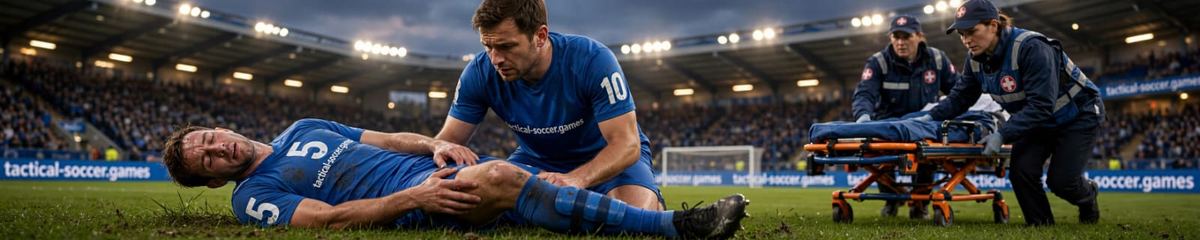
- When they happen: injuries are not rolled in the middle of a match, but when the squad "ages" a year (a real day passes or 20 matches are played). There is no risk up to age 25; after that the chance rises 2.5 points for every year of age, up to a maximum of 35%.
- How long they last: most are short knocks of 2 to 6 matches; 1 in 4 is serious and rules the player out for 1 to 3 years. Match-based injuries count down by one for every match you play.
- What they mean: an injured player does not count as positioned in his spot, cannot train and, if you sell him, only 15% of his value is paid.
- Healing sooner: if you hire a Doctor in the Technical Staff, his medical packs (Basic, Advanced or Full) shorten or cure a player's injury. Every new injury is also logged in News with a "View report" link showing the details.
- Your only outfield player: if you have a single outfield player and your money doesn't cover signing the cheapest replacement, that player can't get injured, so you never end up with nobody able to play.
Energy
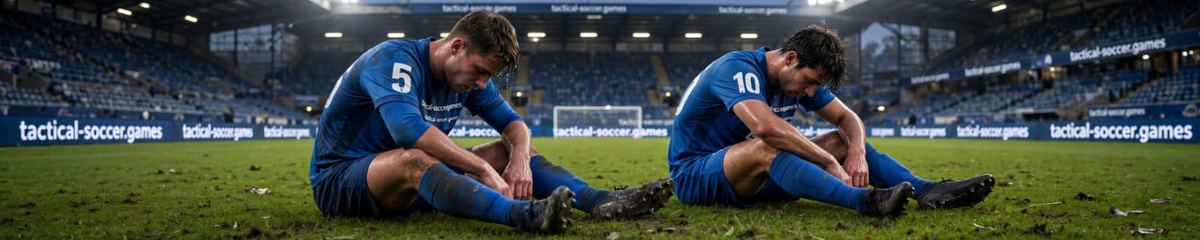
- What it is: the player's fuel, from 0 to 100. The whole squad spends energy when playing: a little with each attacking advance (less the better your team's Pass, more if the rival cuts the play) and a closing cost of 5 to 10 points depending on the goals you concede (5 if you concede none, 10 if you concede 3 or more).
- What happens at 0: the starter runs out of energy and stops counting as positioned in his cell until he recovers it. If it happens during a match, you get a "ran out of energy" News item with its "View report".
- How it recovers: by training. Every minigame adds Energy points on top of the skill it works on, so training is also how you get the team back in shape.
- Age ceiling: from age 35, each year takes 10 points off the maximum energy a player can accumulate.
Frequently asked questions
How do I start playing Tactical Soccer?
Go to tactical-soccer.games and tap "Play now". You start with a base squad and no money: you train your starting player with the minigames, look for your first match in Local League to start earning a budget, and from there you sign more players on the transfer market. No account needed — progress saves automatically in your browser. Your Club Director then guides you with 7 starter goals and pays you a prize for each one.
How do I get promoted or relegated?
The Local League has 10 divisions of 20 teams each. Each season lasts 19 matchdays (a single round-robin against every other team in your division); when the season ends, the top 3 in your division get promoted to the division above and the bottom 3 get relegated to the division below (except in League 1, the top division, where there's no promotion, and League 10, the bottom division, where there's no relegation).
What happens if I lose a Local League match?
Nothing serious: you add a loss to your record, you don't earn the extra money for a win (but you still collect your stadium's fixed payout, if you have one), and your team loses some energy just like in any match played. There are no extra penalties, and you never lose your squad.
What does each of the 13 minigames train?
Tactical Order (Attack + Energy), Tiki-Taka Memory (Pass + Energy), Find the Match (Defense + Energy), Auto Sequence (Defense + Pass + Attack + Energy), Keeper Formation (Defense + Energy), Quick Touch (Pass + Energy), Penalty Kick (Attack + Energy), Precision Shot (Defense + Pass + Attack + Energy), Find & Evade Rivals (Defense + Pass + Attack + Energy), Timed Shooting (Attack + Energy, unlocks once you reach League 9), Game Vision (Pass + Energy, unlocks once you reach League 8), Intercept Pass (Defense + Energy, unlocks once you reach League 7), and Mental Sprint (Defense + Pass + Attack + Energy, unlocks once you reach League 6).
What types of minigames are there and what skills do they demand?
The 13 minigames fall into four types of challenge. Reflexes: Quick Touch, Intercept Pass, Precision Shot and Timed Shooting, which demand timing, motor anticipation, aim, precision and hand-eye coordination. Visual speed: Game Vision and Find the Match, which demand visual discrimination, processing speed, selective attention and pattern recognition. Memory: Penalty Kick, Keeper Formation and Tiki-Taka Memory, which demand visual, iconic, photographic and visuospatial memory. Logic: Tactical Order, Find and Evade Rivals, Auto Sequence and Mental Sprint, which demand mental arithmetic, mental agility, cognitive processing speed, sequencing, cognitive flexibility, inhibitory control and visuospatial skill.
How do my skills combine with my player's skills?
On every play of a match, your result in the minigame (your reflexes, memory, visual speed or logic, depending on the play) combines with the real attributes of the player involved (Defense, Pass or Attack) to decide whether the play works out. A player with better stats gives you more room for error, but you still need a strong performance yourself: you win with the combination of both.
How do I get called up to the National Team?
Two things need to be true at once: a player on your squad has to finish 1st (or tied for 1st) in goals, assists, defensive recoveries or clean sheets across your ENTIRE League when the season ends, AND that same player has to clear an extra challenge specific to their position in Training mode (for example, reaching a certain level in one of that position's minigames). The call-up is granted automatically as soon as both conditions are met — you can see what's left for each position under your squad's Achievements.
Can I play against friends?
Yes, two ways. You can add other players as Friends (by searching for their club) and challenge them straight to a friendly without needing to remember their username, or play International Friendlies against any other real club that also has the feature enabled. Both modes keep head-to-head statistics.
What are Tournaments?
A separate competition inside Competition mode, Public (anyone can join) or Private (by invitation or with a password), where the organizer picks the number of teams and the start date. The format depends on that number: 2 teams play a series of 3, 5, 7 or 9 matches; 3, 4, 5 or 7 play a round robin of 1 or 2 legs; 6, 12 or 24 form groups of 3, with the top 2 from each group advancing to a full knockout bracket; and 8, 16 or 32 start straight in a knockout bracket. Each match has 24 hours to be played and either team can play it early; a tied knockout crossing is decided with a random penalty-shootout minigame. The champion (and, in larger tournaments, other positions too) wins money and, depending on the tournament's size, training or medical packs for your Technical Staff.
Are there in-app purchases?
No. All the game's money is a virtual currency earned by playing matches, collecting your stadium's payout and sponsor payments — there is no real-money payment anywhere in the game.
Do I lose my progress if I switch devices?
If you play without signing in, progress is saved only in that browser. Signing in (optional) saves your progress to the cloud, so you can continue from any device. If two devices have different progress, the game shows a “Two versions of your game” notice with both side by side so you can choose which one to keep; the one you discard stays as a backup copy on that device, and you can restore it from the Profile.
Can I play without an internet connection?
Yes. By installing Tactical Soccer as an app (PWA) from your browser, you can keep training your squad and playing Local League matches offline; data syncs once the connection comes back, if you have an account.
What are Penalties, and can I play them with friends who have a better squad?
It's a shootout of 5 minigames where each round goes to whoever scores higher, so your squad doesn't affect the result and you can compete on equal terms with friends of any level. There are three modes: solo (practice against a computer-controlled keeper, which adds skill to the players you're training), 1-vs-1 (a penalties challenge to a friend or another club, with a skill and energy reward for the winner) and Penalty Tournament (with in-game prizes, not real money). Whoever wins more rounds wins and, if tied, an extra round is played. Challenges and tournaments require signing in and saving your progress to the cloud.
What do I do if I'm out of money, out of fit players or out of credit?
That's normal: the game starts with no money, and every real day counts as one year for your club, so when you come back after days or weeks your players have aged, salaries have been charged (your balance can end up in the red), there were injuries and skills dropped from not training. Options: play Local League matches (a win or a draw pays money, and if you own a stadium you collect its revenue win or lose); play Penalties, where your squad doesn't affect the result; claim the daily reward at the Training Ground and complete Challenges, which give money; request a loan (only with a balance of $0 or more and if you don't already have an active one; it's repaid in yearly installments); sell a player you don't use (you can never sell your last outfield player); and sign young players once you have funds. As a last resort, 'Reset account' in your Profile starts over from scratch, but it erases ALL your progress, including your position in the rankings, and can't be undone. Your Club Director also warns you when you are short on money for what comes next, and the “What do I do now?” guide is always available in the Profile.
How do I get better players?
By signing them on the transfer market (filterable by price, age and skills) as your budget allows, or by developing the players you already have by training them with the minigames, which permanently raise their attributes.
What happens when a player gets injured?
He is out for 2 to 6 matches (short injury) or 1 to 3 years (serious, 1 in 4). An injured player does not count as positioned on the pitch, cannot train and sells for only 15% of his value. Injuries appear when the squad ages a year (every real day or every 20 matches), with a risk that starts at age 25 and rises to a maximum of 35%. They heal as matches go by, or sooner with the medical packs of the Technical Staff Doctor, and each one is logged in News with its "View report".
What is energy for and how does it recover?
Energy (0 to 100) is spent by playing: a little on each attacking advance and 5 to 10 points at the end of every match depending on the goals conceded. A starter who reaches 0 is out of energy and stops counting as positioned in his spot, and you get a News item about it. It recovers by training: every minigame adds Energy. From age 35 the maximum a player can accumulate drops 10 points per year.
What is the Club Director and how does it help me get started?
It is the game's assistant: a card on the main screen that suggests one goal at a time — put your player on the pitch, train him, play your first match, sign your 2nd player, build a starting lineup of 3, buy the stadium and get promoted to League 9 — and pays you a cash prize for each one. It also warns you when something could get you stuck (injured players, a tired squad, expired contracts or a lack of money) and takes you to the screen where it gets solved. You can see all the goals under Profile → “My goals”. Once you complete all 7, it suggests Challenges, one per category, and sends you to the Challenges screen to claim the prizes.
What does the Club Director's face mean?
It shows how your club is doing: worried if you are in the relegation zone (places 18 to 20) or if any starter is injured or out of energy; happy, with a thumbs-up, if you are in the promotion zone (places 1 to 3) and all your starters are fit; and neutral in every other case.
What happens if I have a single outfield player and he gets injured?
If you have a single outfield player and your money doesn't cover signing the cheapest replacement, that player doesn't get injured, so you never end up with nobody able to play. As soon as you can afford a replacement, the normal injury risk applies again (from age 25). And you can never sell your last outfield player.
What are Challenges and how do I claim their prizes?
They are long-term club targets, grouped by category (First steps, Penalty shootouts, Streaks and Club and squad). Each has up to 3 tiers with bronze, silver and gold medals, and each tier gives cash and skill points for the player you choose. The prize is claimed from the Challenges screen (the trophy in the top bar), never expires and can't be collected twice. League Achievements, with bigger prizes, are grouped there too: Promotions and Leagues, Championships, Performance and Club and community.
How does the Penalty Challenge work?
It has three levels and is completed by playing penalties in each of its three modes, in any order: a practice shootout against the CPU, a friendly penalty shootout with a friend (P2P) and a tie of a penalty shootout tournament. Every different mode you play raises one level.